
The Empty Tank: What Happens When Runners Under-Fuel

Updated: Apr 30
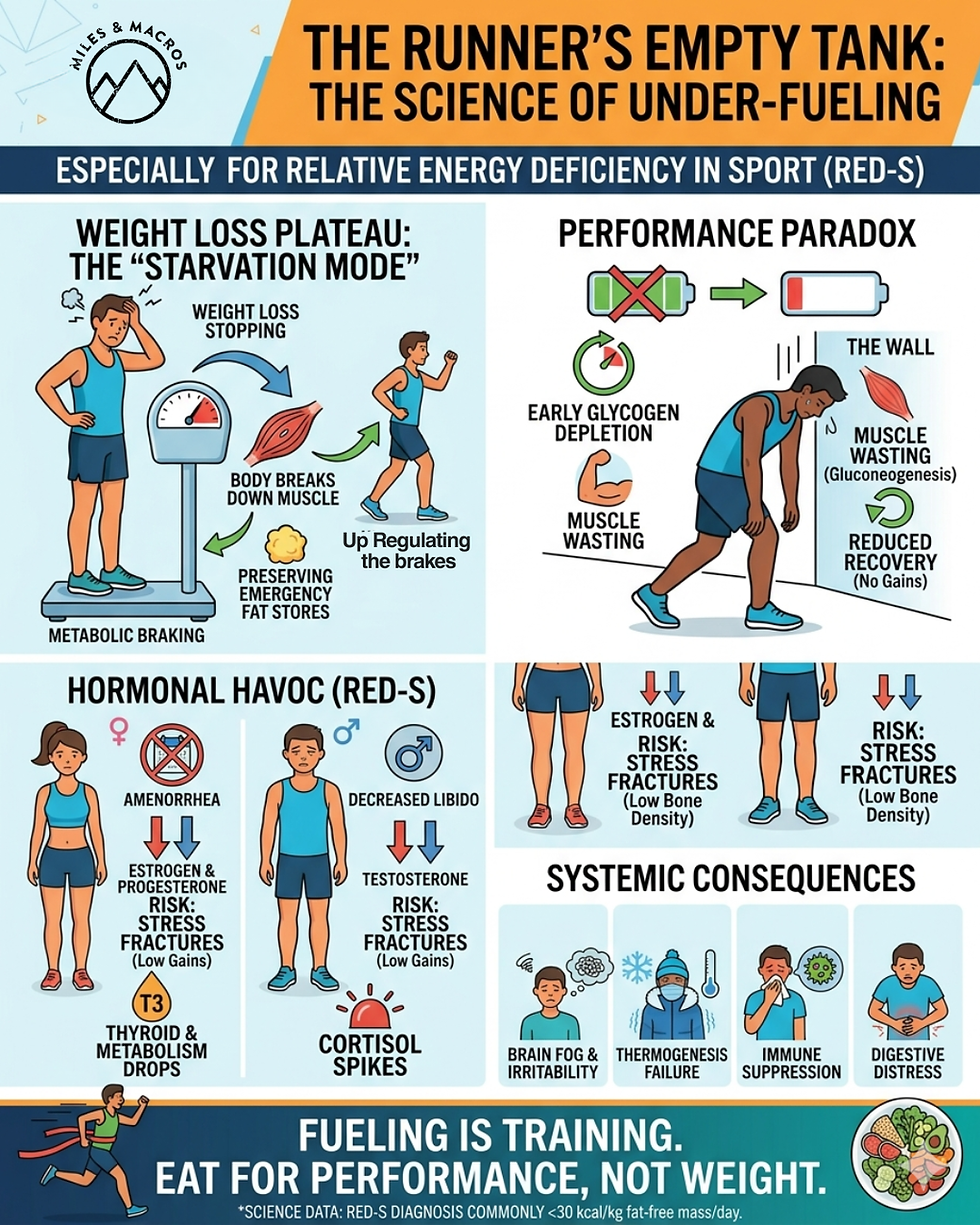
In the world of distance running, there is a persistent, whispering myth: Lighter is faster. It’s a siren song that leads many athletes to cut calories in hopes of hitting a PR. But here is the cold, hard truth—your body is not a calculator; it’s a biological engine. When you stop putting gas in the tank, the engine doesn’t just run slower; it starts to dismantle itself for spare parts.
This physiological state is known as Low Energy Availability (LEA), and when it becomes chronic, it leads to a syndrome called Relative Energy Deficiency in Sport (RED-S). Here is the science of what happens when you try to outrun a bad fueling strategy.
1. The Weight Loss Wall: "Starvation Mode"
Perhaps the most frustrating irony for runners trying to lean out is that under-fueling eventually backfires on the scale.
When you consistently consume fewer calories than your body needs to support both basic life functions and your mileage, you trigger Adaptive Thermogenesis—colloquially known as "Starvation Mode." Metabolic Braking: Your body perceives a famine. To survive, it downregulates its metabolic rate, burning fewer calories at rest to preserve energy for vital organs.
The Weight Loss Plateau: Eventually, weight loss stops entirely. Your body becomes incredibly "efficient" at holding onto fat stores as an insurance policy, often breaking down muscle tissue for energy instead because muscle is "metabolically expensive" to maintain.
Body Composition Shifts: You may find your "power-to-weight" ratio actually worsening as you lose functional muscle while your body clings to every gram of emergency body fat.
2. Performance Paradox
Without adequate fuel, the physiological response makes you significantly slower, regardless of what the scale says.
Glycogen Depletion: Without adequate carbohydrates, your muscles lack their primary high-intensity fuel source. You’ll hit "the wall" much earlier in long runs.
Muscle Wasting: In a calorie deficit, the body enters a catabolic state, breaking down its own muscle tissue (via gluconeogenesis) to create glucose.
Reduced Recovery: Your "repair window" after a workout essentially slams shut. Repairing micro-tears in muscle requires energy; without it, you stay sore longer and see zero gains from your hard efforts.
3. Hormonal Havoc: Men vs. Women
While the end result (injury and burnout) is the same, the hormonal paths differ slightly between genders.
Feature | Impact on Female Runners | Impact on Male Runners |
Key Hormone | Estrogen & Progesterone drop significantly. | Testosterone levels plummet. |
Primary Symptom | Amenorrhea: Loss of menstrual cycle (a major red flag). | Decreased Libido and persistent morning fatigue. |
Metabolism | T3 (Thyroid hormone) drops to conserve energy. | Similar drop in T3, leading to a "sluggish" feeling. |
Stress Response | Cortisol spikes, leading to "tired but wired" feelings. | Cortisol spikes, hindering muscle protein synthesis. |
A Note on Bone Health: For both genders, the drop in sex hormones is catastrophic. Estrogen and testosterone are "bone-protective." Without them, your bones become porous, turning a minor ache into a stress fracture.
4. Physical & Systemic Changes
Under-fueling doesn't just affect your legs; it affects every system in your body.
The Brain Fog: Your brain consumes about 20% of your daily calories. Under-fueling leads to irritability, poor concentration, and a loss of "competitive drive."
Thermogenesis Failure: Do you find yourself wearing a puffer jacket when it’s 65°F? That’s your slowed metabolism struggling to maintain core body temperature.
Immune Suppression: Your body views "fighting a cold" as a luxury it can't afford. Under-fueled runners often find themselves trapped in a cycle of recurring infections.
Digestive Distress: Ironically, eating too little can cause bloating and "slow gut." The body slows down digestion to squeeze every possible calorie out of what little food it receives.
5. The Scientific "Red Flags"
Research suggests that once energy availability drops below 30 kcal/kg of fat-free mass per day, the body begins to shut down non-essential functions.
Resting Heart Rate (RHR) Ch
anges: You might notice an unusually low RHR (bradycardia) as the heart muscle weakens, or a sudden spike in RHR because your body is under immense stress.
Hematological Issues: Low iron (anemia) is common, as the body lacks the energy to produce red blood cells efficiently.
Cardiac Strain: In severe cases, the heart—which is a muscle—actually shrinks in size, leading to dangerous arrhythmias.
The Takeaway: Fueling is Training
We often think of "training" as only the miles logged on the GPS watch. But fueling is a discipline, just like speed work. You cannot build a skyscraper with a shortage of bricks, and you cannot build a faster version of yourself on a caloric deficit.
If you want to run long and run strong, you have to give your body the resources it needs to stay "online." Eat for the work you're doing, not the weight you think you should be. Remember: A well-fueled runner will beat an under-fueled, "leaner" runner almost every time—simply because they have the energy to finish the race.


Comments